EXPERIENCE DESIGN · UNSW SYDNEY · IN PROGRESS
DesigningResearcher profiles
Helping researchers promote themselves online to increase partnership, global funding and collaboration opportunities.
ROLE
Lead Experience Designer
DURATION
8 months (on going)
DISCIPLINES
Product strategy · UX research
Facilitation · Content design
REACH
60% of organic traffic
to Research site
30
deep-dive interviews
with academics
150+
researchers engaged
in co-design workshops
25
interviews with
external industry partners
THE PROBLEM
How can we leverage researcher profiles?
UNSW needed a stronger way to showcase their research impact so they could secure more funding and global partnerships. Researcher profiles were designed to help the university with this goal by providing a space for researchers to promote their work online. They’re also a key entry point for the university, bringing in 60% of all organic traffic to the Research site. The high traffic and high industry awareness of these profiles made them a great opportunity to leverage, if only they were fit-for-purpose!
Researchers rarely used their profiles because they were difficult to update and failed to provide the flexibility for researchers to promote their work how they wanted to.
MY APPROACH
Changing tact
A new UI design had been completed by an external agency that was almost ready to ship. My role was to make minor UX improvements and redesign the back-end experience. After my first round of user testing I discovered a dissonance between how researchers naturally spoke about their work and the structure and language used in the new profile design.
I raised these concerns with stakeholders, explaining how the existing approach was trying to impose a new frame of thinking on researchers - people who already had very specific, deeply held ways of understanding their own work. If we didn’t try to understand and apply the mental model of researchers, the profiles would remain an underutilised resource.
There was some initial pushback as they'd already invested in the agency work, but ultimately they understood the problem and gave me the green light to redirect energy to a deeper discovery phase. Woo!
Brief V1
Test the new UI and ship it.
Brief V2
Understand how researchers actually think about their work, their reputation, and their audience and design a profile to suit their needs.
My research approach
01
User testing and an open card sort
5 researchers individually categorised and ranked profile content - separating what they felt was important for themselves vs their audience. This surfaced a critical disconnect immediately.
02
15 deep-dive interviews with researchers
I stepped back from UI entirely to ask some key questions: How do you know you've done a good job? How do you show expertise? Who would you like to view your profile, and what do they need to know? Participants built their own profile canvas as they spoke.
03
100+ researcher open forum feedback session
I translated insights into a prototype and ran an open feedback session for all UNSW research staff. Over 100+ researchers attended. This generated a massive dataset and created institutional buy-in for the new direction.
04
25 external user interviews
Industry partners, journalists, government agencies, venture capital, and academics from other institutions. Understanding the full journey of how they find, vet, and collaborate with researchers.
Research artefacts
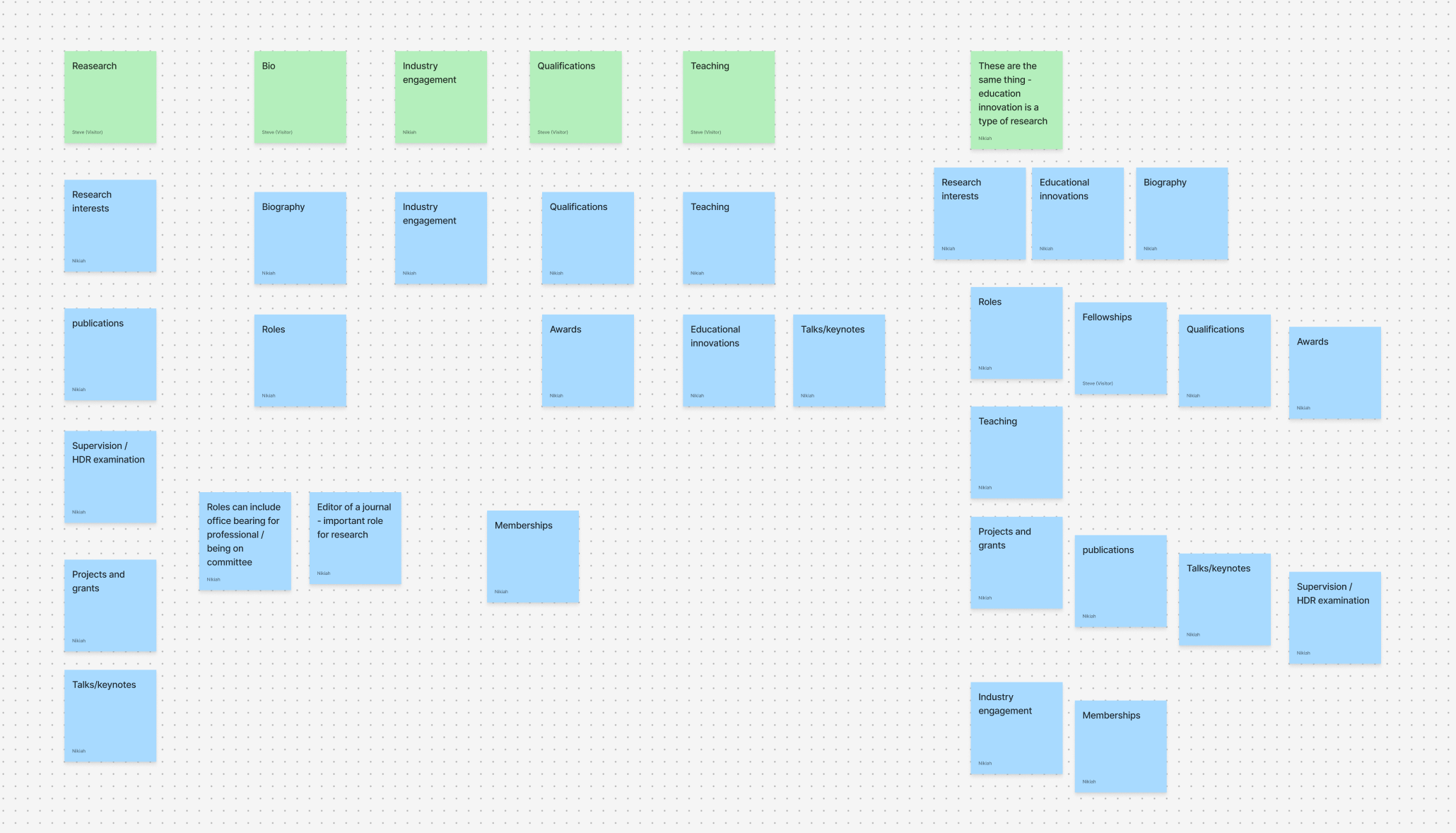
Card sorting activity with a researcher
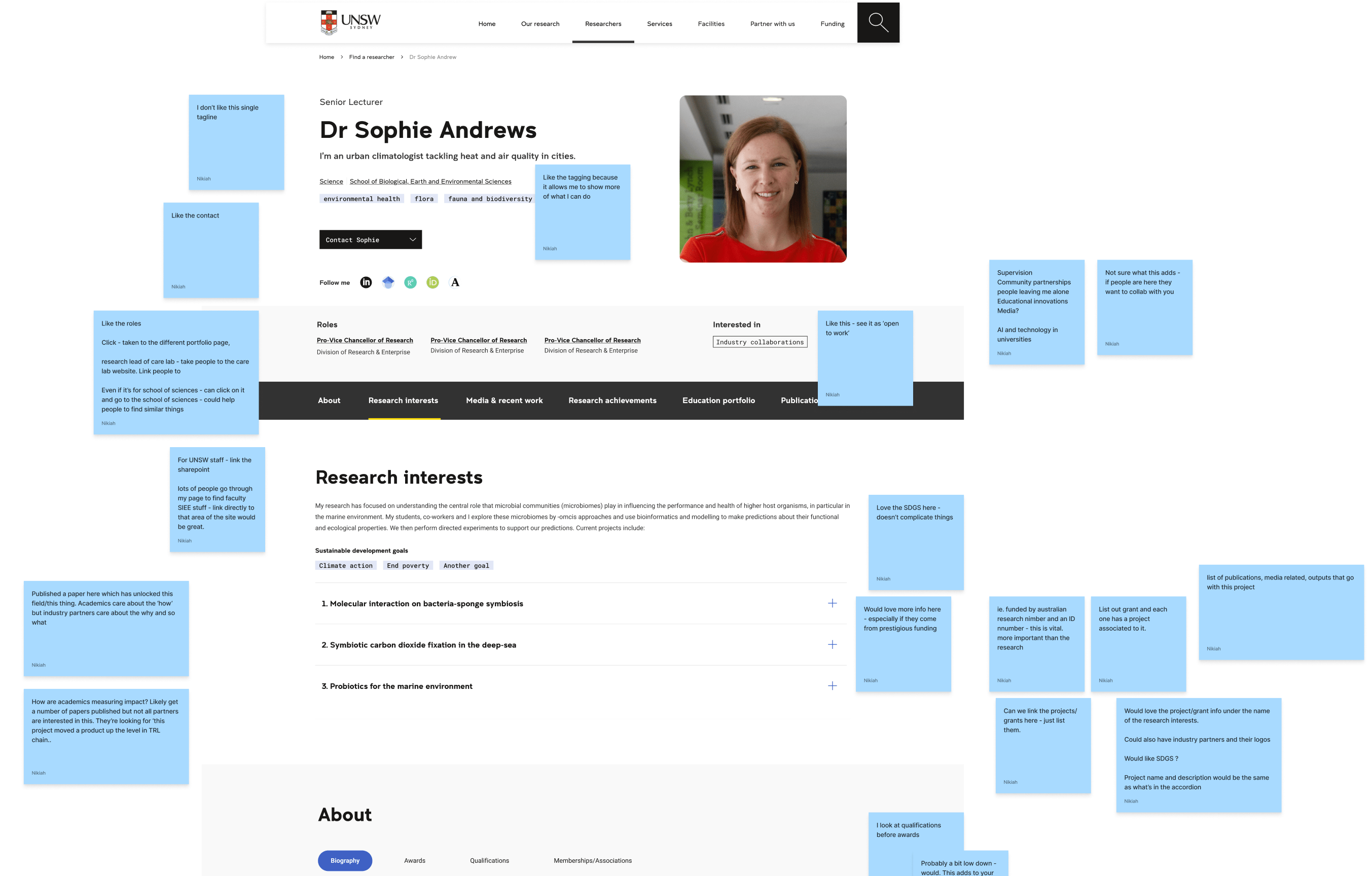
Round 2 user testing feedback
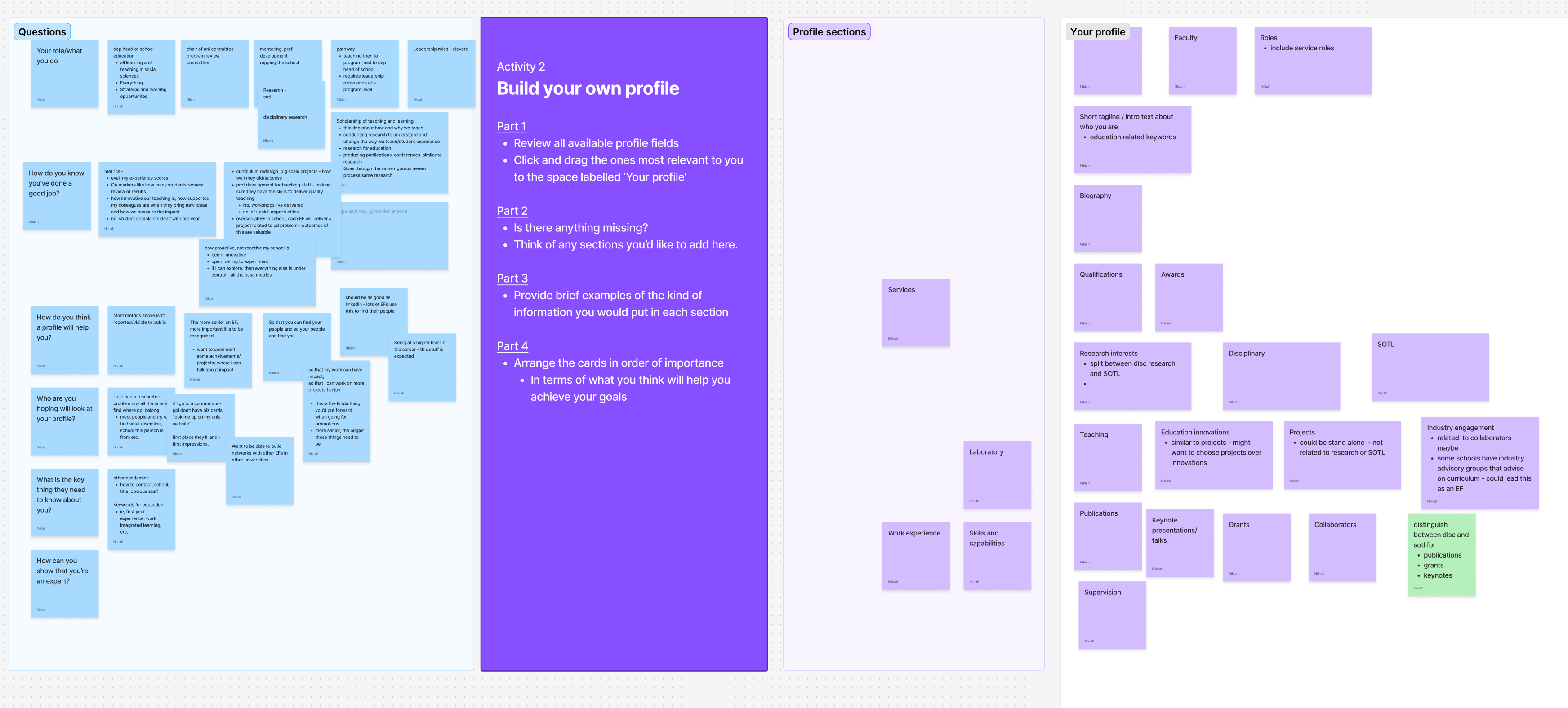
Mental model mapping exercise
Raw notes from qualitative user interviews and ‘build your own profile’ exercise.
KEY FINDINGS
What the research revealed
BARRIER
Research is the priority - nothing else competes
Researchers ignore anything that doesn't directly help their research. If updating a profile feels like a chore, they won't do it. If they don’t understand how the profile will directly advance their research goals, they won’t touch it.
BARRIER
Self-promotion feels like a chore or too intimidating
Every single researcher I spoke to acknowledged that promoting themselves online was important. None of them felt equipped to do it well. They weren't marketers. They didn't know what to prioritise or how to speak to audiences different from their academic peers. The profile gave them a blank canvas and expected them to know what to paint.
KILLER INSIGHT
"I want to find my people"
This was the finding that changed everything. Researchers aren't primarily trying to broadcast credentials - they're trying to find the right people to work with. Academics with shared values, shared methods, shared ambition. They want to increase their surface area of opportunity by connecting with people who get it. The profile, as designed, had no mechanism for any of that.
INSIGHT
No shared language among researchers
The card sort revealed that researchers use similar words to describe fundamentally different things. 'Impact', 'collaboration', 'expertise' - everyone used these terms, but they mapped to entirely different mental models. This meant any one-size-fits-all content structure would be wrong for most people most of the time.
INSIGHT
Researchers and their audiences have different priorities
What researchers think is important about themselves is not what they think is important to show their audience. They consistently ranked their own interests differently from what they believed external visitors needed. A profile that optimised for researcher expression at the expense of audience comprehension, or vice versa, would fail both groups.
INSIGHT
External users want validation, not a CV
25 interviews with industry partners, journalists, and government bodies revealed a consistent pattern. They arrive after already hearing about a researcher. The profile isn't where the sale is made - it's where credibility is confirmed. "I want to know they are who they say they are." Speed of validation matters more than depth of detail.
KEY VALUE PROPOSITION
Researcher profiles need to be a good ‘front door’
The profile is just one part of the vetting process and should highlight their current work, research vision and emphasise their highest impact achievements.
Provide a good first impression that incites interest. The ‘sale’ isn’t closed by the profile, it’s a lengthy process involving ongoing conversations and meetings.
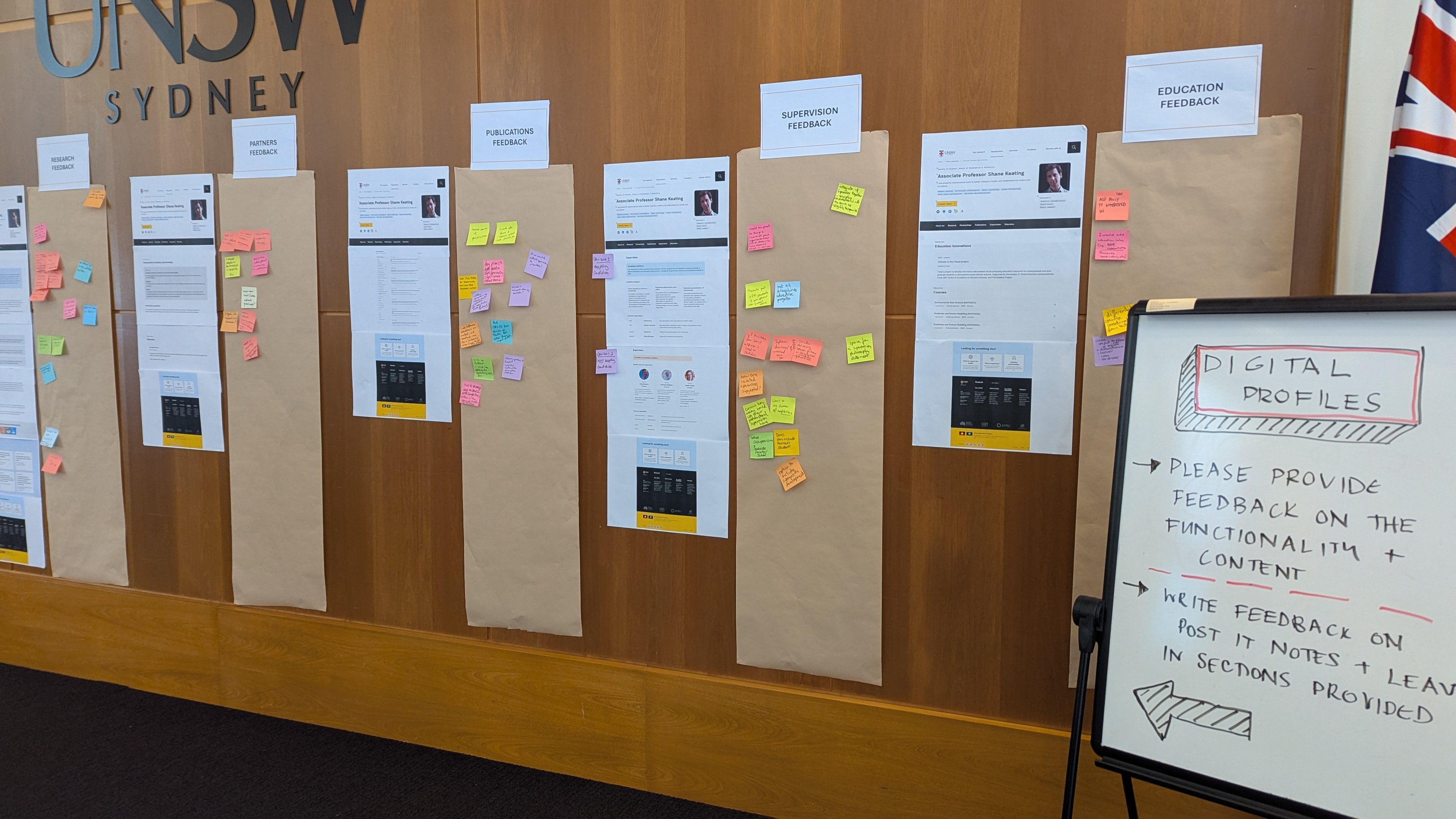
Open forum workshop
Structured as a ‘walk the walls’ session. Participants could view the printed research profile designs and add feedback via post-its.
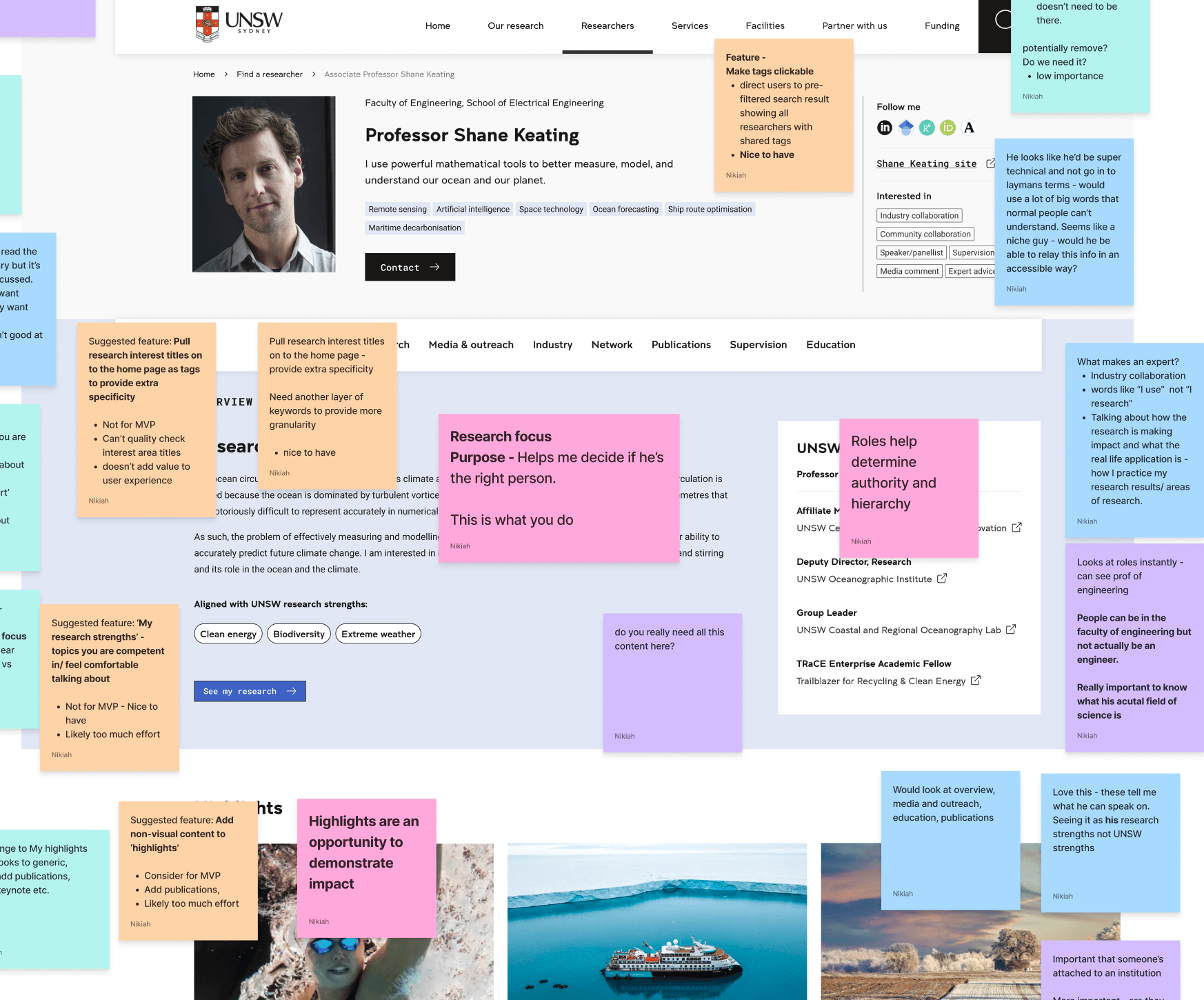
Consolidating feedback from external users
Identifying the proof points for validation and purpose of each section of the profile.
THE DESIGN SOLUTION
From mental model to profile structure
By stepping away from the UI and mapping how researchers actually think about their work, reputation, and collaboration, I redesigned the content hierarchy from scratch - balancing researchers' need for self-expression with audiences' need for quick validation.
INSIGHT
‘Research Focus’ section to articulate their ‘why’
Researchers can now articulate their 'why' - a mission statement for their research or teaching philosophy. For education-focused academics this captures their teaching approach too. This is the section that most directly serves the 'find my people' need. It lets other researchers quickly assess whether they share values, vision, and direction.
INSIGHT
‘Network’ section to show collaborators
A new section showing who the researcher collaborates with, and surfacing other researchers with shared interests and methods. This turns a static profile into a discovery tool - audiences can see who's in the periphery of this researcher and use that network to sense-check credibility and explore further.
INSIGHT
‘Collaboration’ tags on projects to sign post opportunities to collab
Small tags on the projects section signal which work the researcher is actively seeking support with. This is a lightweight but powerful change - it transforms the profile from a retrospective record into a forward-looking signal of intent, making it much easier for potential collaborators to identify an opening.
INSIGHT
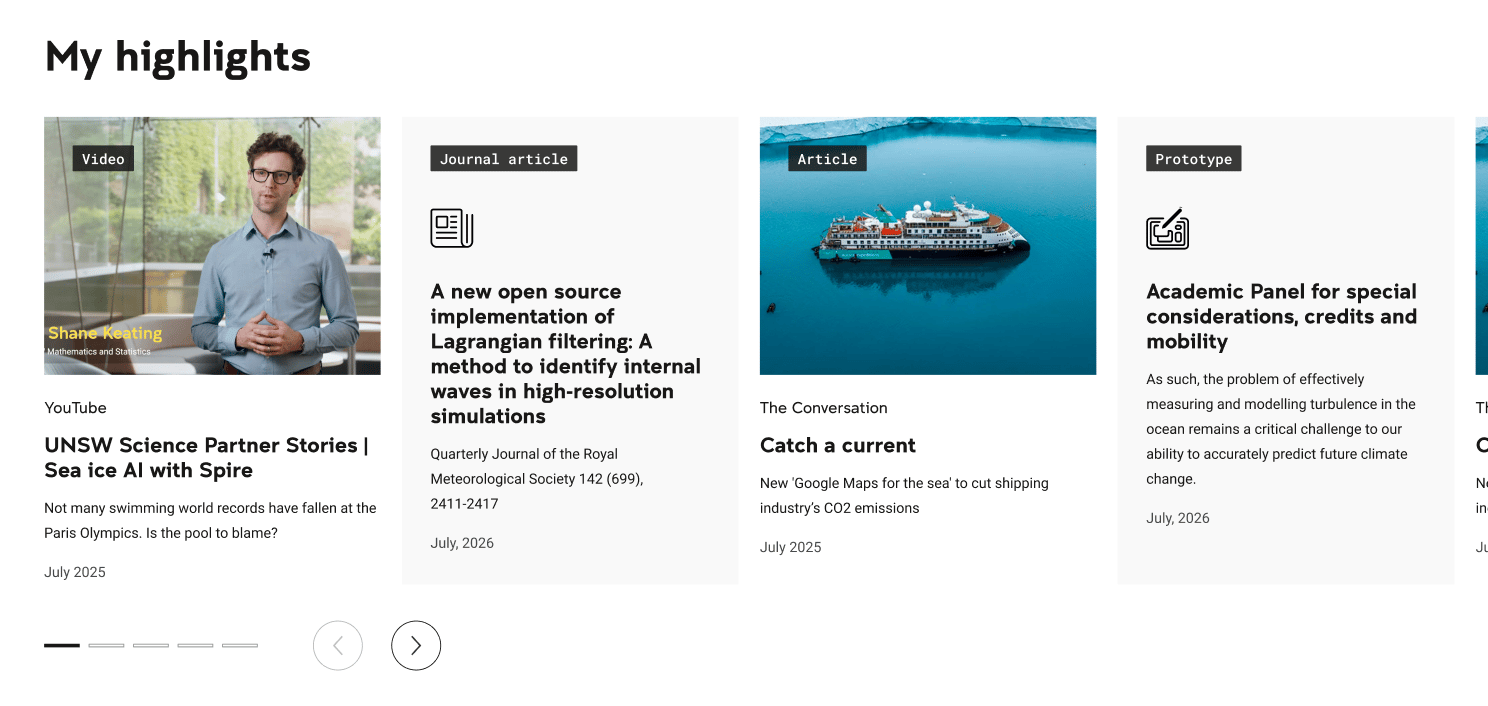
Flexible ‘Highlights’ section to showcase their best work
A freeform section for media, featured publications, and other work that doesn't fit standard academic categories. Informed directly by the insight that researchers have vastly different output types and no shared vocabulary for describing them - the highlights section is deliberately format-agnostic.
The redesigned profile
Key screens from the new profile design, informed by 55+ hours of research and co-design.
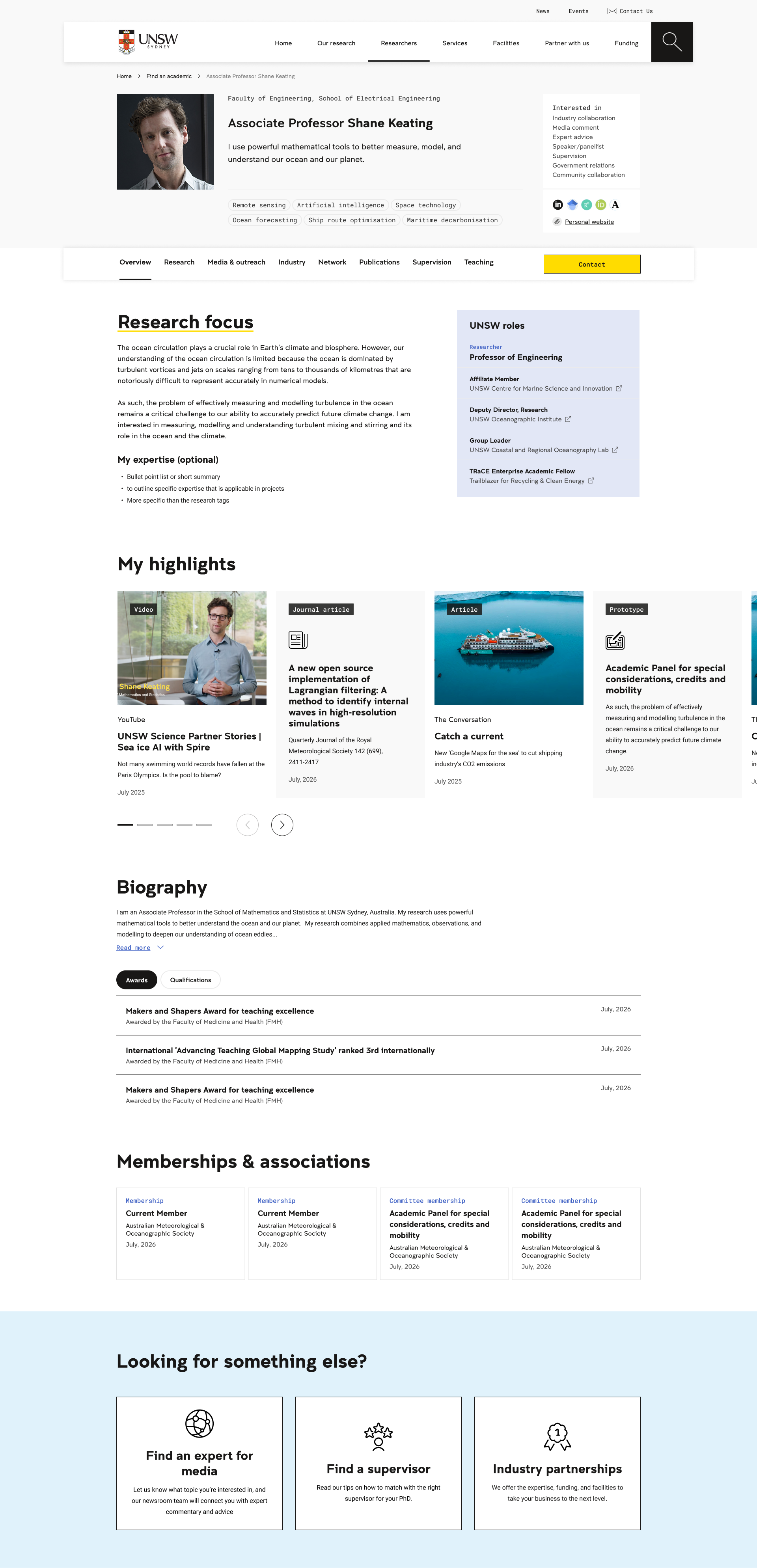
New hero banner, research focus and roles.
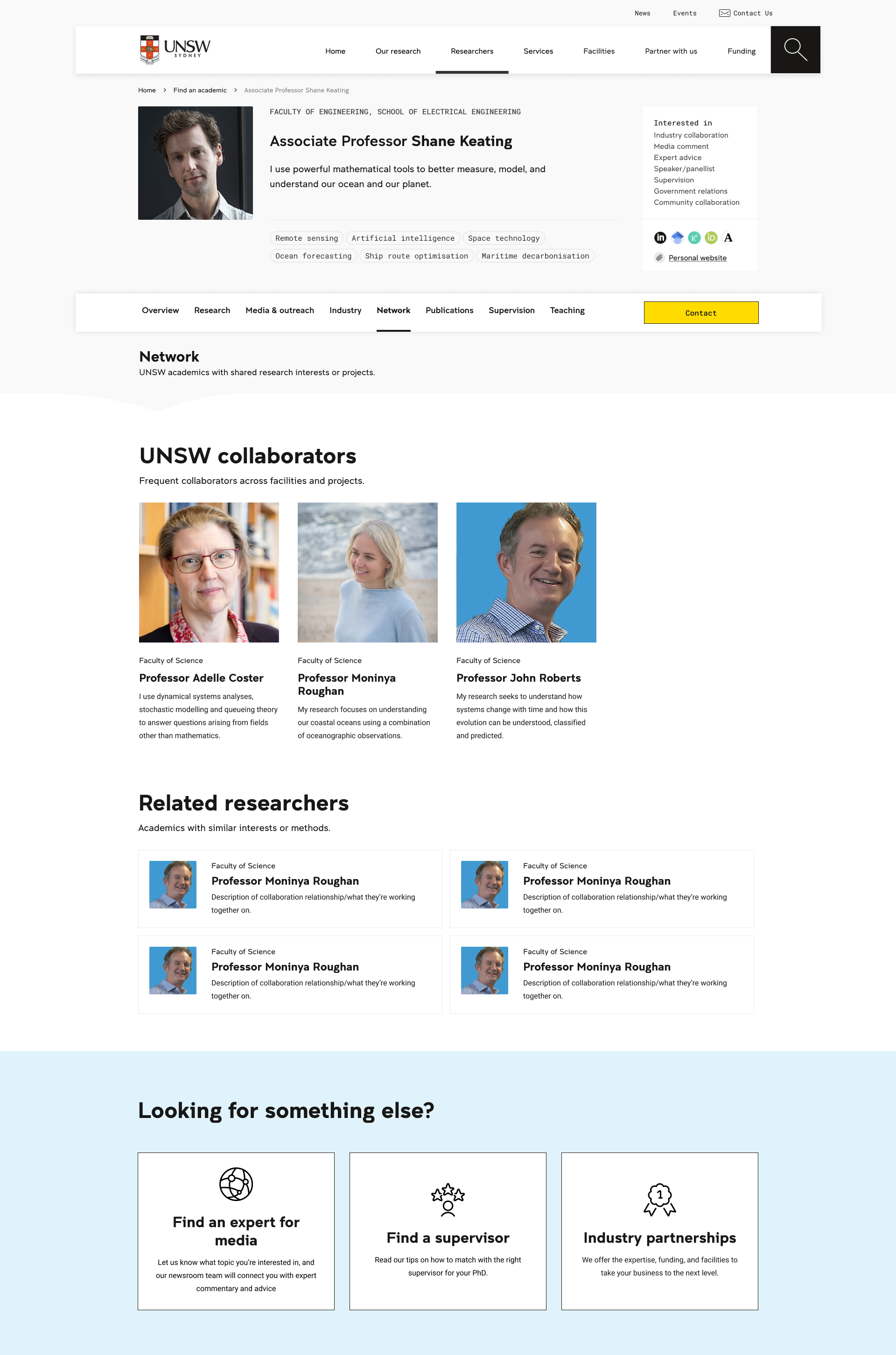
Network section
Storyboard panel 4. Carer and shower scene (sensitive customer)
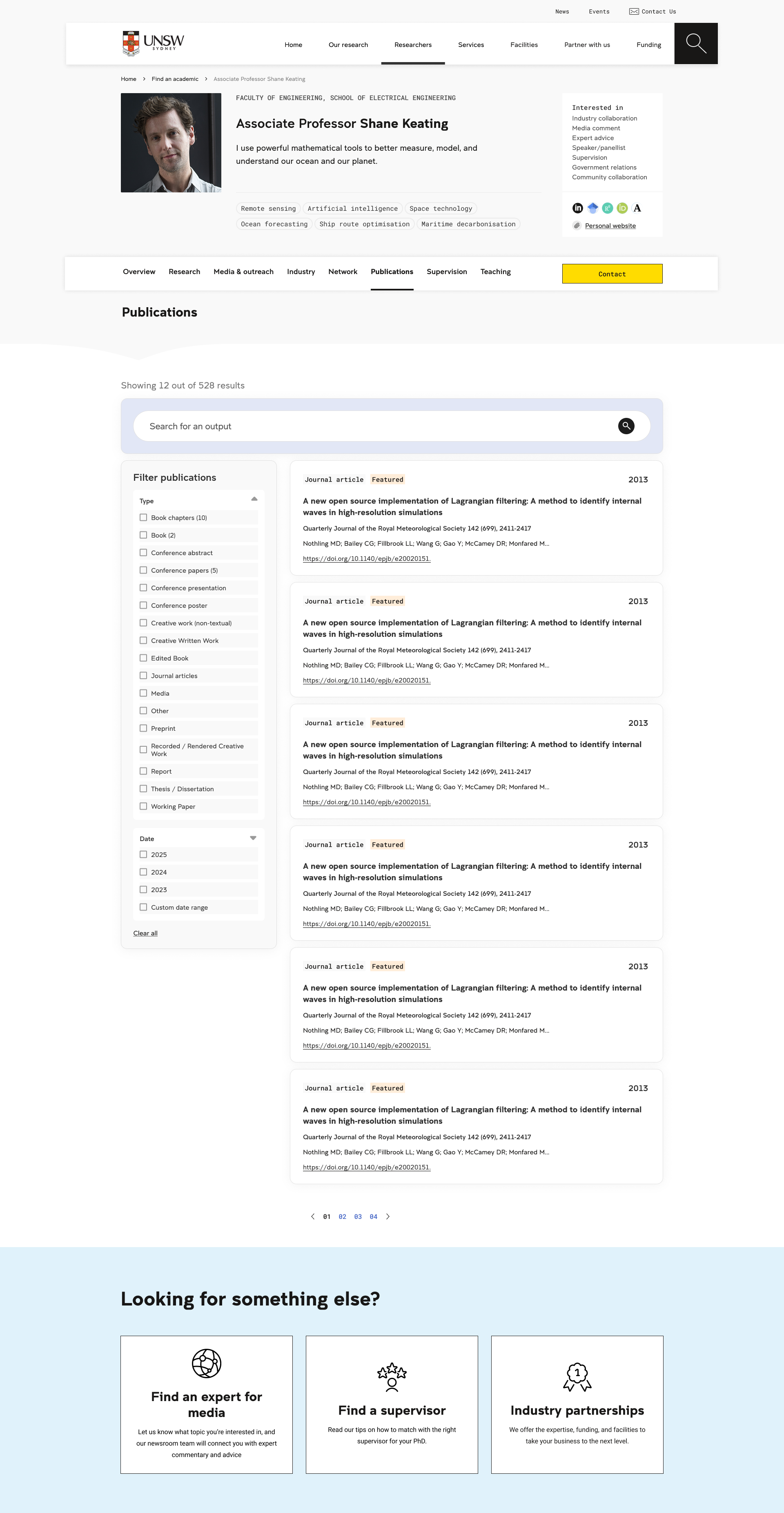
New publication section showing evidence of outputs.
IMPACT & OUTCOMES
Institutional alignment and great feedback
The workshops created a space for academics and stakeholders to share ideas and collaborate in a way they haven’t before. During these sessions, they uncovered common problems and developed a kinship with researchers from different faculties and backgrounds.
We delivered more than The project was commissioned to improve a web product. What it delivered, alongside this, was something harder to engineer. Researchers from different faculties sitting in the same room, discovering they shared the same problems. It's rare for academics to collaborate across faculty lines. The co-design process created those conditions naturally.
Education-focused researchers in particular surfaced specific challenges that had never been formally identified before. The workshops became a vehicle for knowledge that had existed in isolation, scattered across faculties, finally finding a shared space.
150+
researchers engaged across 6 facilitated workshops and one large forum session
55+
hours of primary research - interviews, card sorts, co-design, external user testing
100+
attendees at the open forum - generating institutional buy-in for the new direction
And some very positive feedback from participants...
"Nikiah ran a workshop today with a group of Education Focused Academics for the researcher profile feedback. It was, to be succinct, excellent.”
“Nikiah has been incredibly helpful on this project, facilitating conversations, eliciting feedback and, critically, transforming it all into a beautiful prototype for the researcher profiles. She's worth her weight in gold."
"Nikiah also deserves all the praise for conducting the workshop so well, listening and helping us process our own ideas."
- Workshop participant
"I appreciated the way you both listened, avoided assumptions, provided space for group negotiation, and gently helped to bring us back together. Too many of these workshops are rushed and dominated by the facilitator voice - today felt refreshingly different."
- Workshop participant
REFLECTION
Navigating the hard parts
There were two difficult moments in this project...
The first was making the call to disregard the agency’s UI design and (almost) start from scratch. There's a particular organisational pressure around near-complete deliverables. Stopping them feels like a failure. Shipping something that doesn't work feels like a success. This was by far the best call and it freed me up to design something flexible and truly fit for purpose, while also collecting brilliant insights we can use on future projects.
The second moment was when I realised the huge disparity in language and needs between researchers. It felt like a near impossible task to synthesise insights when the variance between both were so large. Moving from individual interviews to multi-disciplinary workshops was a great solution for this. Researchers had to create shared definitions in real time and find compromises in the design to meet their conflicting needs.
All projects
Refining My Wellbeing
Designing a product to help students with their mental health.
Read case study →
DesigningResearcher profiles
Helping researchers promote themselves online to increase partnership, global funding and collaboration opportunities.
Read case study →
Mapping
Water outages
Mapping the end-to-end water outage experience to drive systemic change for Water Corporation.
Read case study →
EXPERIENCE DESIGN · UNSW SYDNEY · IN PROGRESS
DesigningResearcher profiles
Helping researchers promote themselves online to increase partnership, global funding and collaboration opportunities.
ROLE
Lead Experience Designer
DURATION
8 months (on going)
DISCIPLINES
Product strategy · UX research
Facilitation · Content design
REACH
60% of organic traffic
to Research site
30
deep-dive interviews
with academics
150+
researchers engaged
in co-design workshops
25
interviews with
external industry partners
THE PROBLEM
How can we leverage researcher profiles?
UNSW needed a stronger way to showcase their research impact so they could secure more funding and global partnerships. Researcher profiles were designed to help the university with this goal by providing a space for researchers to promote their work online. They’re also a key entry point for the university, bringing in 60% of all organic traffic to the Research site. The high traffic and high industry awareness of these profiles made them a great opportunity to leverage, if only they were fit-for-purpose!
Researchers rarely used their profiles because they were difficult to update and failed to provide the flexibility for researchers to promote their work how they wanted to.
MY APPROACH
Changing tact
A new UI design had been completed by an external agency that was almost ready to ship. My role was to make minor UX improvements and redesign the back-end experience. After my first round of user testing I discovered a dissonance between how researchers naturally spoke about their work and the structure and language used in the new profile design.
I raised these concerns with stakeholders, explaining how the existing approach was trying to impose a new frame of thinking on researchers - people who already had very specific, deeply held ways of understanding their own work. If we didn’t try to understand and apply the mental model of researchers, the profiles would remain an underutilised resource.
There was some initial pushback as they'd already invested in the agency work, but ultimately they understood the problem and gave me the green light to redirect energy to a deeper discovery phase. Woo!
Brief V1
Test the new UI and ship it.
Brief V2
Understand how researchers actually think about their work, their reputation, and their audience and design a profile to suit their needs.
My research approach
01
User testing and an open card sort
5 researchers individually categorised and ranked profile content - separating what they felt was important for themselves vs their audience. This surfaced a critical disconnect immediately.
02
15 deep-dive interviews with researchers
I stepped back from UI entirely to ask some key questions: How do you know you've done a good job? How do you show expertise? Who would you like to view your profile, and what do they need to know? Participants built their own profile canvas as they spoke.
03
100+ researcher open forum feedback session
I translated insights into a prototype and ran an open feedback session for all UNSW research staff. Over 100+ researchers attended. This generated a massive dataset and created institutional buy-in for the new direction.
04
25 external user interviews
Industry partners, journalists, government agencies, venture capital, and academics from other institutions. Understanding the full journey of how they find, vet, and collaborate with researchers.
Research artefacts
Card sorting activity with a researcher
Round 2 user testing feedback
Mental model mapping exercise
Raw notes from qualitative user interviews and ‘build your own profile’ exercise.
KEY FINDINGS
What the research revealed
BARRIER
Research is the priority - nothing else competes
Researchers ignore anything that doesn't directly help their research. If updating a profile feels like a chore, they won't do it. If they don’t understand how the profile will directly advance their research goals, they won’t touch it.
BARRIER
Self-promotion feels like a chore or too intimidating
Every single researcher I spoke to acknowledged that promoting themselves online was important. None of them felt equipped to do it well. They weren't marketers. They didn't know what to prioritise or how to speak to audiences different from their academic peers. The profile gave them a blank canvas and expected them to know what to paint.
KILLER INSIGHT
"I want to find my people"
This was the finding that changed everything. Researchers aren't primarily trying to broadcast credentials - they're trying to find the right people to work with. Academics with shared values, shared methods, shared ambition. They want to increase their surface area of opportunity by connecting with people who get it. The profile, as designed, had no mechanism for any of that.
INSIGHT
No shared language among researchers
The card sort revealed that researchers use similar words to describe fundamentally different things. 'Impact', 'collaboration', 'expertise' - everyone used these terms, but they mapped to entirely different mental models. This meant any one-size-fits-all content structure would be wrong for most people most of the time.
INSIGHT
Researchers and their audiences have different priorities
What researchers think is important about themselves is not what they think is important to show their audience. They consistently ranked their own interests differently from what they believed external visitors needed. A profile that optimised for researcher expression at the expense of audience comprehension, or vice versa, would fail both groups.
INSIGHT
External users want validation, not a CV
25 interviews with industry partners, journalists, and government bodies revealed a consistent pattern. They arrive after already hearing about a researcher. The profile isn't where the sale is made - it's where credibility is confirmed. "I want to know they are who they say they are." Speed of validation matters more than depth of detail.
KEY VALUE PROPOSITION
Researcher profiles need to be a good ‘front door’
The profile is just one part of the vetting process and should highlight their current work, research vision and emphasise their highest impact achievements.
Provide a good first impression that incites interest. The ‘sale’ isn’t closed by the profile, it’s a lengthy process involving ongoing conversations and meetings.
Open forum workshop
Structured as a ‘walk the walls’ session. Participants could view the printed research profile designs and add feedback via post-its.
Consolidating feedback from external users
Identifying the proof points for validation and purpose of each section of the profile.
THE DESIGN SOLUTION
From mental model to profile structure
By stepping away from the UI and mapping how researchers actually think about their work, reputation, and collaboration, I redesigned the content hierarchy from scratch - balancing researchers' need for self-expression with audiences' need for quick validation.
INSIGHT
‘Research Focus’ section to articulate their ‘why’
Researchers can now articulate their 'why' - a mission statement for their research or teaching philosophy. For education-focused academics this captures their teaching approach too. This is the section that most directly serves the 'find my people' need. It lets other researchers quickly assess whether they share values, vision, and direction.
INSIGHT
‘Network’ section to show collaborators
A new section showing who the researcher collaborates with, and surfacing other researchers with shared interests and methods. This turns a static profile into a discovery tool. Audiences can see who's in the periphery of this researcher and use that network to sense-check credibility and explore further.
INSIGHT
‘Collaboration’ tags on projects to sign post opportunities to collab
Small tags on the projects section signal which work the researcher is actively seeking support with. This is a lightweight but powerful change - it transforms the profile from a retrospective record into a forward-looking signal of intent, making it much easier for potential collaborators to identify an opening.
INSIGHT
Flexible ‘Highlights’ section to showcase their best work
A freeform section for media, featured publications, and other work that doesn't fit standard academic categories. Informed directly by the insight that researchers have vastly different output types and no shared vocabulary for describing them - the highlights section is deliberately format-agnostic.
The redesigned profile
Key screens from the new profile design, informed by 55+ hours of research and co-design.
New hero banner, research focus and roles.
Network section
Storyboard panel 4. Carer and shower scene (sensitive customer)
New publication section showing evidence of outputs.
IMPACT & OUTCOMES
Institutional alignment and great feedback
The workshops created a space for academics and stakeholders to share ideas and collaborate in a way they haven’t before. During these sessions, they uncovered common problems and developed a kinship with researchers from different faculties and backgrounds.
We delivered more than The project was commissioned to improve a web product. What it delivered, alongside this, was something harder to engineer. Researchers from different faculties sitting in the same room, discovering they shared the same problems. It's rare for academics to collaborate across faculty lines. The co-design process created those conditions naturally.
Education-focused researchers in particular surfaced specific challenges that had never been formally identified before. The workshops became a vehicle for knowledge that had existed in isolation, scattered across faculties, finally finding a shared space.
150+
researchers engaged across 6 facilitated workshops and one large forum session
55+
hours of primary research - interviews, card sorts, co-design, external user testing
100+
attendees at the open forum - generating institutional buy-in for the new direction
And some very positive feedback from participants...
"Nikiah ran a workshop today with a group of Education Focused Academics for the researcher profile feedback. It was, to be succinct, excellent.”
“Nikiah has been incredibly helpful on this project, facilitating conversations, eliciting feedback and, critically, transforming it all into a beautiful prototype for the researcher profiles. She's worth her weight in gold."
"Nikiah also deserves all the praise for conducting the workshop so well, listening and helping us process our own ideas."
- Workshop participant
"I appreciated the way you both listened, avoided assumptions, provided space for group negotiation, and gently helped to bring us back together. Too many of these workshops are rushed and dominated by the facilitator voice - today felt refreshingly different."
- Workshop participant
REFLECTION
Navigating the hard parts
There were two difficult moments in this project...
The first was making the call to disregard the agency’s UI design and (almost) start from scratch. There's a particular organisational pressure around near-complete deliverables. Stopping them feels like a failure. Shipping something that doesn't work feels like a success. This was by far the best call and it freed me up to design something flexible and truly fit for purpose, while also collecting brilliant insights we can use on future projects.
The second moment was when I realised the huge disparity in language and needs between researchers. It felt like a near impossible task to synthesise insights when the variance between both were so large. Moving from individual interviews to multi-disciplinary workshops was a great solution for this. Researchers had to create shared definitions in real time and find compromises in the design to meet their conflicting needs.
All projects
Refining My Wellbeing
Designing a product to help students with their mental health.
Read case study →
DesigningResearcher profiles
Helping researchers promote themselves online to increase partnership, global funding and collaboration opportunities.
Read case study →
Mapping
Water outages
Mapping the end-to-end water outage experience to drive systemic change for Water Corporation.
Read case study →
EXPERIENCE DESIGN · UNSW SYDNEY · IN PROGRESS
DesigningResearcher profiles
Helping researchers promote themselves online to increase partnership, global funding and collaboration opportunities.
ROLE
Lead Experience Designer
DURATION
8 months (on going)
DISCIPLINES
Product strategy · UX research
Facilitation · Content design
REACH
60% of organic traffic
to Research site
30
deep-dive interviews
with academics
150+
researchers engaged
in co-design workshops
25
interviews with
external industry partners
THE PROBLEM
How can we leverage researcher profiles?
UNSW needed a stronger way to showcase their research impact so they could secure more funding and global partnerships. Researcher profiles were designed to help the university with this goal by providing a space for researchers to promote their work online. They’re also a key entry point for the university, bringing in 60% of all organic traffic to the Research site. The high traffic and high industry awareness of these profiles made them a great opportunity to leverage, if only they were fit-for-purpose!
Researchers rarely used their profiles because they were difficult to update and failed to provide the flexibility for researchers to promote their work how they wanted to.
MY APPROACH
Changing tact
A new UI design had been completed by an external agency that was almost ready to ship. My role was to make minor UX improvements and redesign the back-end experience. After my first round of user testing I discovered a dissonance between how researchers naturally spoke about their work and the structure and language used in the new profile design.
I raised these concerns with stakeholders, explaining how the existing approach was trying to impose a new frame of thinking on researchers - people who already had very specific, deeply held ways of understanding their own work. If we didn’t try to understand and apply the mental model of researchers, the profiles would remain an underutilised resource.
There was some initial pushback as they'd already invested in the agency work, but ultimately they understood the problem and gave me the green light to redirect energy to a deeper discovery phase. Woo!
Brief V1
Test the new UI and ship it.
Brief V2
Understand how researchers actually think about their work, their reputation, and their audience and design a profile to suit their needs.
My research approach
01
User testing and an open card sort
5 researchers individually categorised and ranked profile content - separating what they felt was important for themselves vs their audience. This surfaced a critical disconnect immediately.
02
15 deep-dive interviews with researchers
I stepped back from UI entirely to ask some key questions: How do you know you've done a good job? How do you show expertise? Who would you like to view your profile, and what do they need to know? Participants built their own profile canvas as they spoke.
03
100+ researcher open forum feedback session
I translated insights into a prototype and ran an open feedback session for all UNSW research staff. Over 100+ researchers attended. This generated a massive dataset and created institutional buy-in for the new direction.
04
25 external user interviews
Industry partners, journalists, government agencies, venture capital, and academics from other institutions. Understanding the full journey of how they find, vet, and collaborate with researchers.
Research artefacts
Card sorting activity with a researcher
Round 2 user testing feedback
Mental model mapping exercise
Raw notes from qualitative user interviews and ‘build your own profile’ exercise.
KEY FINDINGS
What the research revealed
BARRIER
Research is the priority - nothing else competes
Researchers ignore anything that doesn't directly help their research. If updating a profile feels like a chore, they won't do it. If they don’t understand how the profile will directly advance their research goals, they won’t touch it.
BARRIER
Self-promotion feels like a chore or too intimidating
Every single researcher I spoke to acknowledged that promoting themselves online was important. None of them felt equipped to do it well. They weren't marketers. They didn't know what to prioritise or how to speak to audiences different from their academic peers. The profile gave them a blank canvas and expected them to know what to paint.
KILLER INSIGHT
"I want to find my people"
This was the finding that changed everything. Researchers aren't primarily trying to broadcast credentials - they're trying to find the right people to work with. Academics with shared values, shared methods, shared ambition. They want to increase their surface area of opportunity by connecting with people who get it. The profile, as designed, had no mechanism for any of that.
INSIGHT
No shared language among researchers
The card sort revealed that researchers use similar words to describe fundamentally different things. 'Impact', 'collaboration', 'expertise' - everyone used these terms, but they mapped to entirely different mental models. This meant any one-size-fits-all content structure would be wrong for most people most of the time.
INSIGHT
Researchers and their audiences have different priorities
What researchers think is important about themselves is not what they think is important to show their audience. They consistently ranked their own interests differently from what they believed external visitors needed. A profile that optimised for researcher expression at the expense of audience comprehension, or vice versa, would fail both groups.
INSIGHT
External users want validation, not a CV
25 interviews with industry partners, journalists, and government bodies revealed a consistent pattern. They arrive after already hearing about a researcher. The profile isn't where the sale is made - it's where credibility is confirmed. "I want to know they are who they say they are." Speed of validation matters more than depth of detail.
KEY VALUE PROPOSITION
Researcher profiles need to be a good ‘front door’
Provide a good first impression that incites interest. The ‘sale’ isn’t closed by the profile, it’s a lengthy process involving ongoing conversations and meetings. The profile is just one part of the vetting process and should highlight their current work, research vision and emphasise their highest impact achievements.
Open forum workshop
Structured as a ‘walk the walls’ session. Participants could view the printed research profile designs and add feedback via post-its.
Consolidating feedback from external users
Identifying the proof points for validation and purpose of each section of the profile.
THE DESIGN SOLUTION
From mental model to profile structure
By stepping away from the UI and mapping how researchers actually think about their work, reputation, and collaboration, I redesigned the content hierarchy from scratch - balancing researchers' need for self-expression with audiences' need for quick validation.
INSIGHT
‘Research Focus’ section to articulate their ‘why’
Researchers can now articulate their 'why' - a mission statement for their research or teaching philosophy. For education-focused academics this captures their teaching approach too. This is the section that most directly serves the 'find my people' need. It lets other researchers quickly assess whether they share values, vision, and direction.
INSIGHT
‘Network’ section to show collaborators
A new section showing who the researcher collaborates with, and surfacing other researchers with shared interests and methods. This turns a static profile into a discovery tool - audiences can see who's in the periphery of this researcher and use that network to sense-check credibility and explore further.
INSIGHT
‘Collaboration’ tags on projects to sign post opportunities to collab
Small tags on the projects section signal which work the researcher is actively seeking support with. This is a lightweight but powerful change - it transforms the profile from a retrospective record into a forward-looking signal of intent, making it much easier for potential collaborators to identify an opening.
INSIGHT
Flexible ‘Highlights’ section to showcase their best work
A freeform section for media, featured publications, and other work that doesn't fit standard academic categories. Informed directly by the insight that researchers have vastly different output types and no shared vocabulary for describing them - the highlights section is deliberately format-agnostic.
The redesigned profile
Key screens from the new profile design, informed by 55+ hours of research and co-design.
New hero banner, research focus and roles.
Network section
Storyboard panel 4. Carer and shower scene (sensitive customer)
New publication section showing evidence of outputs.
IMPACT & OUTCOMES
Institutional alignment and great feedback
The workshops created a space for academics and stakeholders to share ideas and collaborate in a way they haven’t before. During these sessions, they discovered common problems which developed a sort of kinship with researchers from different faculties and backgrounds. It's rare for academics to collaborate across faculties and the co-design process created those conditions naturally.
Education-focused researchers in particular surfaced specific challenges that had never been formally identified before. The workshops became a vehicle for knowledge that had existed in isolation, scattered across faculties, finally finding a shared space.
150+
researchers engaged across 6 facilitated workshops and one large forum session
55+
hours of primary research - interviews, card sorts, co-design, external user testing
100+
attendees at the open forum - generating institutional buy-in for the new direction
And some very positive feedback from participants...
"Nikiah ran a workshop today with a group of Education Focused Academics for the researcher profile feedback. It was, to be succinct, excellent.”
“Nikiah has been incredibly helpful on this project, facilitating conversations, eliciting feedback and, critically, transforming it all into a beautiful prototype for the researcher profiles. She's worth her weight in gold."
"Nikiah also deserves all the praise for conducting the workshop so well, listening and helping us process our own ideas."
- Workshop participant
"I appreciated the way you both listened, avoided assumptions, provided space for group negotiation, and gently helped to bring us back together. Too many of these workshops are rushed and dominated by the facilitator voice - today felt refreshingly different."
- Workshop participant
REFLECTION
Navigating the hard parts
There were two difficult moments in this project...
The first was making the call to disregard the agency’s UI design and (almost) start from scratch. There's a particular organisational pressure around near-complete deliverables. Stopping them feels like a failure. Shipping something that doesn't work feels like a success. This was by far the best call and it freed me up to design something flexible and truly fit for purpose, while also collecting brilliant insights we can use on future projects.
The second moment was when I realised the huge disparity in language and needs between researchers. It felt like a near impossible task to synthesise insights when the variance between both were so large. Moving from individual interviews to multi-disciplinary workshops was a great solution for this. Researchers had to create shared definitions in real time and find compromises in the design to meet their conflicting needs.
All projects
Refining My Wellbeing
Designing a product to help students with their mental health.
Read case study →
DesigningResearcher profiles
Helping researchers promote themselves online to increase partnership, global funding and collaboration opportunities.
Read case study →
Mapping
Water outages
Mapping the end-to-end water outage experience to drive systemic change for Water Corporation.
Read case study →